
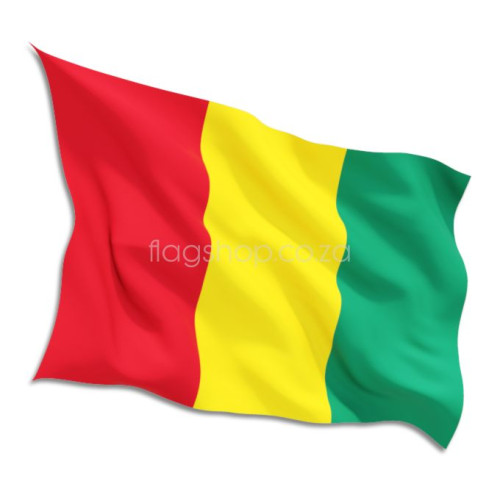
The national flag of Guinea (French: drapeau national de la Guinée) is a triband of red, yellow, and green. It was adopted on 10 November 1958, with the publication of the country's first Constitution. It uses the Pan-African colours, partly as a nod to the flag of Ghana, whose president was a close associate of Sekou Toure, the first Guinean president. It is a tricolour resembling the flag of France, its former coloniser.
The colours of the flag were adapted from those of the Rassemblement Démocratique Africain, the dominant movement at the time of independence. The colors were in turn derived from those of the flag of Ghana, which had first adopted them in 1957. Sékou Touré, the first President of Guinea, was a close associate of Kwame Nkrumah, the former president of Ghana.
According to Sékou Touré, first President of Guinea, the three colours of the flag represent the following: red symbolizes the blood of anti-colonialist martyrs, the labour of the working classes, and the wish for progress; yellow represents Guinean gold, as well as the sun, which is "the source of energy, generosity and equality for all men to which he gives light equally"; and green represents the country's vegetation, continued prosperity arising from its natural resources, and the historically difficult life of the Guinean masses who live in the countryside. In turn, the symbolism behind each of the three colours corresponds to the three components of the national motto: Travail, Justice, Solidarité ("Work, Justice, Solidarity").
In keeping with other flags in the region, the Pan-African movement's colours of red, yellow, and green are used. Wikipedia
| Product Specifications | |
| Finish | Finished with rope and toggle. Ready for hoisting |
| Material | 100% Polyester Bunting. The REAL flag material. Suited for conditions such as intense UV radiation, moist, salty air and high winds. |
Tags: country flags