
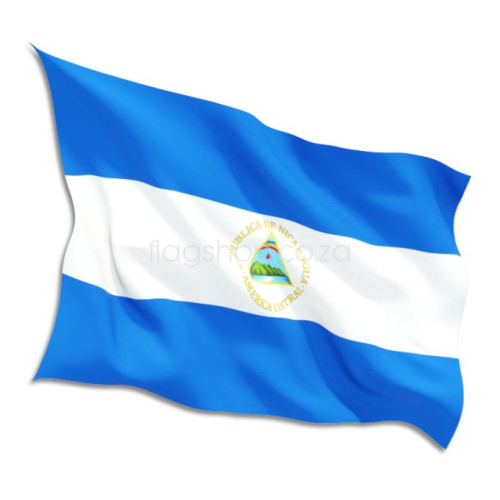
The flag of Nicaragua was first adopted on September 4, 1908, but not made official until August 27, 1971. It is based on, and inspired by, the flag of the Federal Republic of Central America, with a blue and white triband and a coat of arms as the charge in the centre. Its flag is one of the few that currently use the color purple, due to the rainbow in its coat of arms.
The flags of Guatemala, El Salvador, Honduras and Costa Rica are also based on the flag of the Federal Republic.
The two Azure bands on the flag and the arms of Nicaragua in use today is derived from that of the United Provinces of Central America. The triangle, volcanoes, rising sun, Cap of Liberty, and rainbow all appeared on the original emblem. The coat of arms used today contains the name of the state, Republica de Nicaragua, whereas in 1823 the title was Provincias Unidas del Centro de America. The decision to revert to the emblems used by the United Provinces of Central America was taken in 1908 and reflected Nicaragua's aspirations for the rebirth of the political entity formed by the 5 nations. Except for the text around the arms, the flag is very similar to that of the United Provinces of Central America. The 5 volcanoes represent the original 5 member states, the Cap of Liberty represents national freedom, and the rays of the sun and the rainbow are symbolic of the bright future to come. Wikipedia
| Product Specifications | |
| Finish | Finished with rope and toggle. Ready for hoisting |
| Material | 100% Polyester Bunting. The REAL flag material. Suited for conditions such as intense UV radiation, moist, salty air and high winds. |
Nicaragua Flags
- Brand: Flag Shop
- Product Code: NIC
- Availability: Please read our Delivery Terms
-
R 295
Available Options
Tags: country flags