
 SUPPLIERS OF QUALITY FLAGS SINCE 2008
SUPPLIERS OF QUALITY FLAGS SINCE 2008
R295
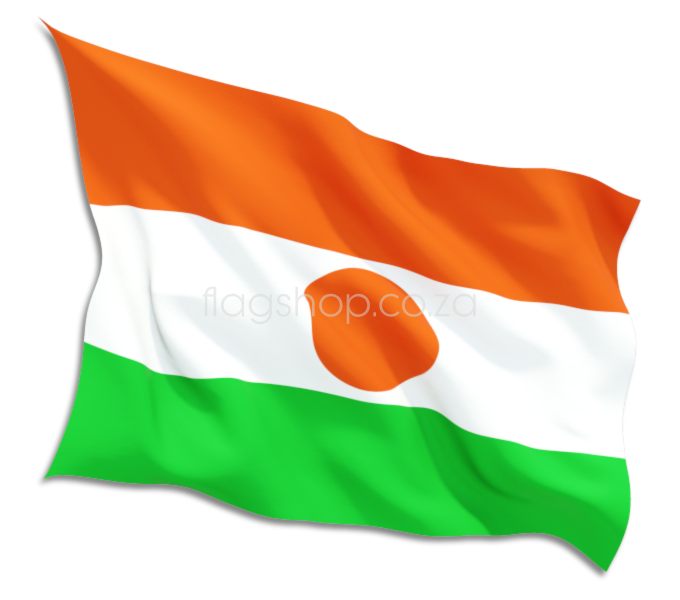
The Flag of Niger has been the national symbol of the West African Republic of Niger since 1959, a year prior to its formal independence from France.
• 90 x 60cm (Storm Size)
• 135 x 90cm (Universal Size)
• 180 x 120cm (Standard Size)
• 270 x 180cm (Ceremonial Size)
• Fitted with header, rope and toggle ready for hoisting
• Material: 100% Polyester Bunting (The Real Flag Material)
• Strikethrough: 97% Ink penetration resulting in a crisp mirror image on the reverse side of the flag
• Reverse Side: Mirror image of front side
Suited for conditions such as intense UV radiation, moist, salty air and high winds.
The average life expectancy of a flag is between 10 and 12 months with normal wear and tear but will differ with fluctuating weather conditions.
Taking care of your flags will prolong the lifespan and keep them looking good.
• Lower your flags at night
• Wash your flags regularly. Dirt can erode fabrics, dull the colours and cause wear
• Inspect your flags for deterioration of stitching and thread and have them repaired
• Expected delivery between 7 to 10 business days
• Free delivery for orders over R1000
The Flag of Niger uses the national colours of orange, white and green, in equal horizontal bands, with an orange rondel in the centre. The flag forms one of the official national symbols of the Republic of Niger, with the coat of arms of Niger, the National Anthem (“la Nigérienne”), the crest (used in the centre of the coat of arms), and the motto: “Fraternité, Travail, Progrès“. These form Article 1 of the first part of the 1999 Constitution of Niger. The Niger flag is similar to the Flag of India, although the ratio, shade of orange, and symbol in the centre differ.
Prior to independence from French West Africa, the flag of Niger was adopted by the Territorial Assembly of the Niger Colony on 23 November 1959, shortly before proclamation of the Republic within the French Community on 18 December 1959. The flag was designed in 1958. It was retained upon independence in 1960 and has remained unchanged through the 1999 Fifth Constitution.
A number of sources have described the symbolic intent of the flag, although official sources are silent upon this. A common interpretation is that the upper orange band represents the northern regions of the Sahara Desert (though this is sometimes said to be the Sahel), the centre white band represents purity (though this is sometimes said to be the River Niger), and the lower green band represents both hope and the fertile regions of southern Niger. The orange circle in the centre band is said to represent the sun or independence. Wikipedia