
 SUPPLIERS OF QUALITY FLAGS SINCE 2008
SUPPLIERS OF QUALITY FLAGS SINCE 2008
R295
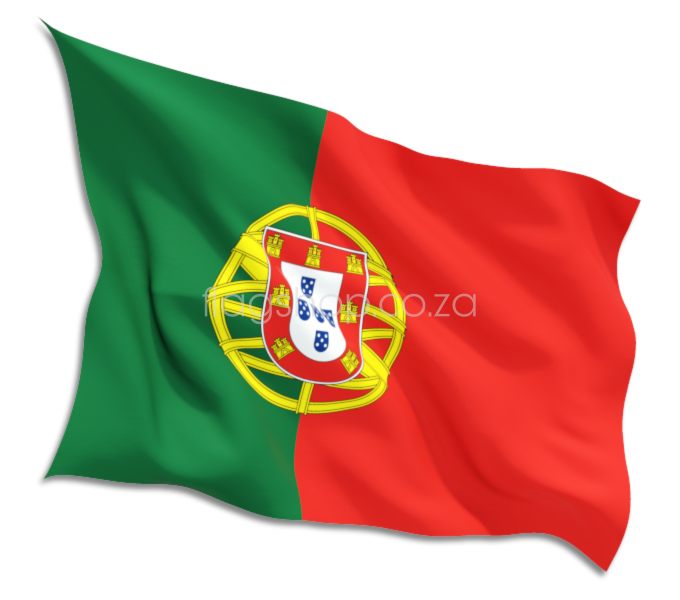
The Flag of Portugal (Portuguese: Bandeira de Portugal) is the national flag of the Portuguese Republic
• 90 x 60cm (Storm Size)
• 135 x 90cm (Universal Size)
• 180 x 120cm (Standard Size)
• 270 x 180cm (Ceremonial Size)
• Fitted with header, rope and toggle ready for hoisting
• Material: 100% Polyester Bunting (The Real Flag Material)
• Strikethrough: 97% Ink penetration resulting in a crisp mirror image on the reverse side of the flag
• Reverse Side: Mirror image of front side
Suited for conditions such as intense UV radiation, moist, salty air and high winds.
The average life expectancy of a flag is between 10 and 12 months with normal wear and tear but will differ with fluctuating weather conditions.
Taking care of your flags will prolong the lifespan and keep them looking good.
• Lower your flags at night
• Wash your flags regularly. Dirt can erode fabrics, dull the colours and cause wear
• Inspect your flags for deterioration of stitching and thread and have them repaired
• Expected delivery between 7 to 10 business days
• Free delivery for orders over R1000
The Flag of Portugal is a rectangular bicolour with a field unevenly divided into green on the hoist, and red on the fly. The lesser version of the national coat of arms (i.e. armillary sphere and Portuguese shield) is centred over the colour boundary at equal distance from the upper and lower edges. On June 30, 1911, less than a year after the downfall of the constitutional monarchy, this design was officially adopted for the new national flag, after selection by a special commission whose members included Columbano Bordalo Pinheiro, João Chagas and Abel Botelho.
The conjugation of the new field colours, especially the use of green, was not traditional in the Portuguese national flag’s composition and represented a radical republican-inspired change that broke the bond with the former religious monarchical flag. Since a failed republican insurrection on January 31, 1891, red and green had been established as the colours of the Portuguese Republican Party and its associated movements, whose political prominence kept growing until it reached a culmination period following the Republican revolution of October 5, 1910. In the ensuing decades, these colours were popularly propagandized as representing the hope of the nation (green) and the blood (red) of those who died defending it, as a means to endow them with a more patriotic and dignified, therefore less political, sentiment.
The current Portuguese flag design represents a dramatic change in the evolution of the Portuguese standard, which had always been closely associated with the royal arms. Since the country’s foundation, the national flag developed from the blue cross-on-white armorial square banner of King Afonso I to the liberal monarchy’s arms over a blue-and-white rectangle. In between, major changes associated with determinant political events contributed to its evolution into the current design. Wikipedia